Artificial Intelligence has moved beyond experimentation.
Today, it’s on every boardroom agenda.
CEOs want AI-powered decision-making. CIOs are evaluating enterprise AI platforms. Operations teams are looking for automation opportunities. Marketing teams are exploring generative AI, while customer support teams are deploying AI assistants.
But amid all the excitement, one critical question is often overlooked:
Is your business actually ready for AI?
Many organizations invest in AI expecting immediate transformation. Instead, they encounter disconnected data, fragmented systems, manual processes, and inconsistent results.
The problem isn’t AI.
The problem is the foundation beneath it.
At Smrkonova, we believe AI is not the starting point of digital transformation—it’s the outcome of building connected business systems.
What is an AI Readiness Framework?
An AI Readiness Framework is a structured approach that helps organisations prepare for successful AI adoption by strengthening their data, business systems, workflows, governance, and decision-making capabilities before implementing AI solutions. Enterprises that establish this foundation are more likely to achieve measurable outcomes from AI initiatives.
Why AI Readiness Matters
Every enterprise wants to leverage AI.
But AI doesn’t operate in isolation.
It depends on accurate data, connected systems, standardized workflows, and well-defined business processes.
Imagine asking an AI assistant to forecast sales.
If your sales team uses one CRM, finance maintains separate spreadsheets, inventory is managed elsewhere, and customer support works in another platform, the AI has no single source of truth.
The output may look intelligent.
But it won’t be reliable.
AI can only enhance what already exists.
If your business processes are disconnected, AI will simply accelerate those inefficiencies.
Why Enterprise AI Projects Struggle
Many organizations approach AI as a technology project.
In reality, it’s a business transformation initiative.
Common reasons enterprise AI initiatives fail include:
- Poor data quality
- Siloed departments
- Legacy systems
- Manual workflows
- Lack of integration
- Undefined business objectives
- Limited governance
Successful organizations don’t begin with AI.
They begin by strengthening the business.
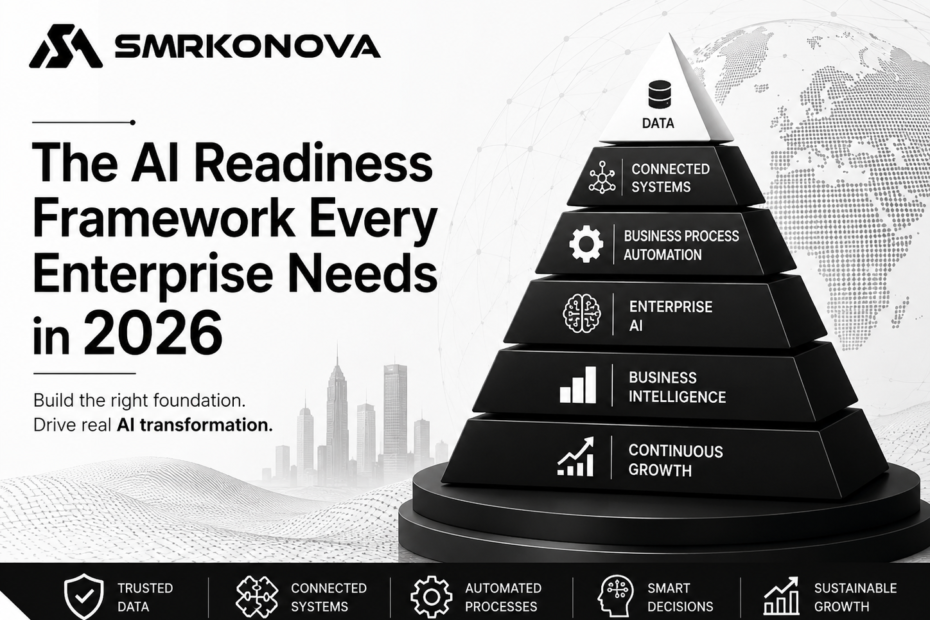
The Smrkonova AI Readiness Framework
Before introducing AI, every enterprise should build a connected digital foundation.
Stage 1 — Data
Every decision begins with trusted information.
Ask yourself:
- Is your business data accurate?
- Is it updated in real time?
- Is everyone working from the same source of truth?
Without reliable data, AI becomes guesswork.
Stage 2 — Connected Business Systems
Technology should work together.
Not separately.
Customer data, ERP, CRM, finance, HR, production, marketing, and analytics should communicate seamlessly.
Disconnected systems create duplicate work.
Connected systems create visibility.
Stage 3 — Business Process Automation
Before introducing intelligence, eliminate repetition.
Automate:
- Customer enquiries
- Sales workflows
- Inventory updates
- Purchase approvals
- Internal notifications
- Reporting
- Document management
Automation creates consistency.
Consistency creates quality data.
Stage 4 — Enterprise AI
Only after building reliable systems should AI be introduced.
AI can then support:
- Predictive analytics
- Intelligent customer support
- Demand forecasting
- Operational optimization
- Quality assurance
- Personalized customer experiences
- Document summarization
- Decision support
AI should enhance human expertise—not replace it.
Stage 5 — Business Intelligence
Data only becomes valuable when it drives decisions.
Business Intelligence dashboards help leadership monitor:
- Revenue trends
- Operational efficiency
- Customer behaviour
- Production performance
- Marketing ROI
- Resource utilization
Insights lead to better decisions.
Better decisions create competitive advantage.
Stage 6 — Continuous Growth
Digital transformation isn’t a one-time project.
Businesses evolve.
Markets change.
Customer expectations shift.
The strongest enterprises continuously improve their systems, processes, and technologies.
Growth becomes a continuous journey—not a destination.
AI Readiness vs AI Adoption
| AI Adoption | AI Readiness |
|---|---|
| Buying AI software | Building a digital foundation |
| Solving isolated tasks | Transforming end-to-end business processes |
| Short-term implementation | Long-term business strategy |
| Tool-focused | Business-focused |
| Reactive | Scalable and sustainable |
The difference isn’t the technology.
It’s the maturity of the business behind it.
Enterprise Statistics
Industry research consistently shows why preparation matters:
- Organizations with integrated data and modern digital infrastructure are significantly more likely to achieve measurable value from AI initiatives.
- Data quality and system integration remain among the biggest barriers to successful AI implementation.
- Enterprises that automate repetitive processes before introducing AI generally realize faster returns on their digital transformation investments.
These trends reinforce a simple reality:
AI succeeds when the business is ready for it.
Case Example
Consider a manufacturing enterprise with multiple plants.
Sales uses a CRM.
Production relies on ERP.
Finance works from separate reporting tools.
Inventory updates happen manually.
Management wants AI-powered forecasting.
The result?
Different departments produce different numbers.
Forecasts become unreliable.
Decision-making slows.
Instead of deploying AI immediately, the organization first connects its systems, standardizes workflows, automates reporting, and creates a unified data environment.
Only then is AI introduced.
Within months, leadership gains reliable forecasting, faster reporting, and greater operational visibility.
The technology didn’t change overnight.
The foundation did.
Enterprise AI Readiness Checklist
Before implementing AI, ask these questions:
✅ Is business data centralized?
✅ Are departments using connected systems?
✅ Have repetitive workflows been automated?
✅ Is reporting available in real time?
✅ Are governance and security policies defined?
✅ Is leadership aligned on AI objectives?
✅ Can business performance be measured consistently?
If several answers are “No,” your first investment shouldn’t be AI.
It should be strengthening your business systems.
FAQ
What is Enterprise AI?
Enterprise AI refers to the use of artificial intelligence across business functions such as operations, finance, customer service, supply chain, manufacturing, and decision-making to improve efficiency and drive business outcomes.
Why is AI readiness important?
Without reliable data, integrated systems, and standardized workflows, AI cannot consistently deliver accurate insights or meaningful business value.
How do I know if my business is ready for AI?
If your organization has connected systems, trusted data, automated workflows, clear governance, and measurable business objectives, you’re in a strong position to adopt AI successfully.
Does AI replace ERP or CRM systems?
No. AI complements ERP and CRM platforms by analyzing data, automating tasks, and generating insights. These systems remain the operational backbone of the business.
What industries benefit most from Enterprise AI?
Manufacturing, healthcare, logistics, financial services, retail, and professional services are among the sectors seeing significant benefits when AI is implemented on top of strong digital foundations.
AI is reshaping how enterprises operate, compete, and innovate.
But successful AI transformation doesn’t begin with selecting the latest model or platform.
It begins with building a business that is ready for intelligence.
Connected systems.
Reliable data.
Automated processes.
Actionable insights.
These are the foundations that allow AI to deliver measurable value.
At Smrkonova, we help enterprises prepare for the future by designing connected digital ecosystems where technology supports people, data drives decisions, and AI becomes a natural extension of an already strong business foundation.
The enterprises that lead in 2026 won’t necessarily be those with the most AI.
They’ll be the ones with the strongest systems.
Is your enterprise truly AI-ready?
Before investing in another AI platform, assess your digital foundation.
At Smrkonova, we help organizations connect their data, modernize business systems, automate workflows, and build AI-ready enterprises designed for long-term growth.
Let’s engineer a business that’s ready for the future—not just the next technology trend.