Every successful business starts small.
A handful of employees.
A few customers.
Simple processes.
In the early days, Microsoft Excel is often the perfect tool. It’s affordable, flexible, and familiar. It helps businesses manage customer lists, sales reports, inventory, expenses, and countless day-to-day operations.
But as a business grows, something changes.
More customers mean more data.
More employees mean more collaboration.
More services mean more processes.
Suddenly, the spreadsheet that once simplified work starts slowing everything down.
The challenge isn’t Excel itself.
The challenge is expecting a spreadsheet to run a business that has outgrown it.
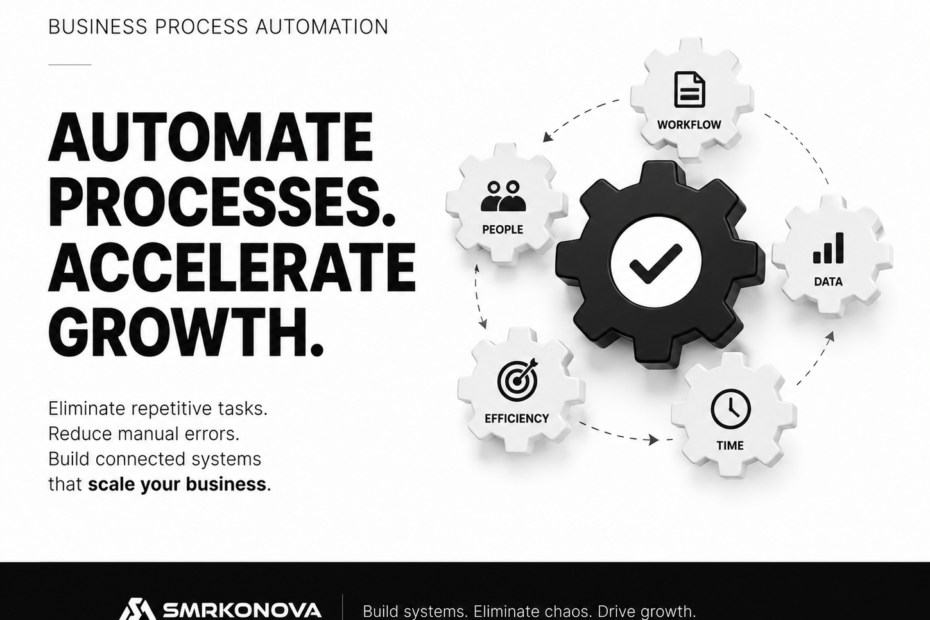
This is where business process automation becomes essential—not just to improve efficiency, but to create a foundation for sustainable growth.
What is Business Process Automation?
Business Process Automation (BPA) is the use of technology to automate repetitive, rule-based business tasks and workflows with minimal human intervention. It helps organizations improve efficiency, reduce errors, lower operational costs, and increase productivity by replacing manual processes with automated systems.
Excel Isn’t the Problem
Let’s be clear.
Excel is an excellent tool.
Millions of businesses use it every day because it is flexible, easy to learn, and powerful for calculations and reporting.
The problem begins when businesses try to use Excel as:
- A CRM
- A project management tool
- An inventory management system
- A reporting platform
- A customer database
- An approval workflow
- A business management system
It was never designed for these purposes.
As businesses expand, spreadsheets become temporary solutions to permanent problems.
The Hidden Cost of Manual Work
Many founders believe their biggest expense is hiring new employees.
In reality, one of the biggest hidden costs is time lost through inefficient processes.
Imagine this scenario.
A sales executive updates customer information in Excel.
The operations team copies the same data into another spreadsheet.
Finance manually enters the information into accounting software.
Management waits until the end of the week for reports.
Each task takes only a few minutes.
But when repeated hundreds of times every month, those minutes become hundreds of lost working hours.
That’s time your team could spend serving customers, improving products, or driving growth.
Five Signs Your Business Has Outgrown Excel
1. Your Team Is Entering the Same Data Multiple Times
If information is copied between spreadsheets, emails, and software applications, your business is creating unnecessary work.
Duplicate data entry increases errors and reduces productivity.
Automation eliminates repetitive tasks by allowing systems to share information automatically.
2. Reports Take Too Long to Generate
Business leaders need timely information to make confident decisions.
If your team spends hours preparing reports every week, you’re not analysing your business.
You’re simply collecting data.
Modern business systems provide real-time dashboards instead of manually generated reports.
3. Different Teams Work with Different Versions of Data
Sales has one spreadsheet.
Finance has another.
Operations has a third.
Everyone believes their version is correct.
Disconnected information creates confusion, delays, and costly mistakes.
Connected business systems ensure everyone works from the same source of truth.
4. Manual Processes Slow Customer Service
Customers expect quick responses.
If employees need to search through multiple spreadsheets before answering a simple question, customer experience suffers.
Business process automation ensures information is available instantly.
5. Growth Creates More Complexity Instead of More Efficiency
One of the biggest warning signs is when hiring new employees actually creates more administrative work.
Healthy businesses scale through systems.
Not spreadsheets.
Why Business Process Automation Matters
Business process automation is the practice of using technology to automate repetitive tasks, connect workflows, and reduce manual effort.
Instead of relying on employees to move information between departments, automation allows systems to communicate automatically.
Examples include:
- Automatically assigning leads from your website to your sales team.
- Sending invoices after an order is confirmed.
- Updating inventory after every purchase.
- Triggering approval workflows for purchase requests.
- Scheduling customer follow-up emails.
- Creating management dashboards in real time.
Automation doesn’t replace people.
It removes repetitive work so people can focus on solving problems and creating value.
Beyond Excel: Building Connected Business Systems
Many businesses respond to operational challenges by purchasing another software tool.
A CRM.
An ERP.
A project management platform.
An inventory system.
Individually, these tools are valuable.
But if they don’t work together, you’ve simply replaced one problem with another.
Disconnected software creates disconnected businesses.
The goal isn’t to collect more applications.
The goal is to build a connected business system.
Imagine a workflow where:
- Your website captures an enquiry.
- The lead automatically enters your CRM.
- The sales team receives an instant notification.
- Follow-up emails are scheduled automatically.
- Customer information flows into your ERP after a sale.
- Finance generates invoices without manual intervention.
- Management views real-time performance dashboards.
This is what connected digital systems look like.
Why Custom Software Often Becomes the Better Choice
Off-the-shelf software works well for common business needs.
However, growing businesses often have unique workflows that generic software cannot support.
That’s where custom software development becomes valuable.
Instead of changing your business to fit the software, custom software is designed around your business processes. It integrates existing tools, removes unnecessary manual work, and supports future growth.
A well-designed solution becomes an investment in long-term efficiency rather than another operational expense.
ERP Alternatives for Growing Businesses
Many business owners assume an ERP is the only solution once Excel becomes difficult to manage.
While ERP platforms can be effective, they aren’t always the right choice.
Depending on your business model, alternatives may include:
- Custom workflow management system
- CRM-first business platforms
- Industry-specific software
- Integrated cloud applications
- Modular business systems built around your operations
The right solution depends on your processes—not just your company size.
A Smarter Approach to Digital Transformation
At Smrkonova, we believe technology should support business growth—not complicate it.
That’s why every digital transformation project begins with understanding the business itself.
Before recommending software, we ask questions like:
- Where is time being lost?
- Which processes are repeated every day?
- Where do departments struggle to share information?
- Which tasks could be automated?
- What will the business look like in five years?
Only then do we design connected systems that align with long-term business goals.
Because successful digital transformation isn’t about implementing more technology.
It’s about creating better experiences for employees, customers, and leadership.
The Future Belongs to Connected Businesses
Businesses today generate more data than ever before.
The companies that succeed won’t necessarily be the ones with the most information.
They’ll be the ones that use information most effectively.
Connected business systems provide:
- Faster decision-making
- Better customer experiences
- Improved operational efficiency
- Reduced manual work
- Higher productivity
- Scalable growth
Most importantly, they allow founders to spend less time managing processes and more time building their business.
Final Thoughts
Excel helped countless businesses get started.
It remains one of the most useful business tools available.
But every business reaches a stage where spreadsheets become limitations instead of solutions.
If your team spends more time updating data than acting on it…
If reports take hours instead of seconds…
If departments operate in silos…
If manual work is slowing growth…
It may be time to move beyond spreadsheets.
Business growth shouldn’t create complexity.
It should create opportunities.
With the right approach to business process automation, connected business systems, and workflow automation, your business can eliminate repetitive work, improve collaboration, and build a stronger foundation for sustainable growth.
At Smrkonova, we help startups, SMEs, and enterprises design connected digital ecosystems where websites, custom software, automation, analytics, and business operations work together—not separately. Because we don’t just build projects. We build systems that help businesses grow.
Frequently Asked Questions
Is Excel still useful for businesses?
Yes. Excel is excellent for analysis, reporting, and small-scale operations. The challenge begins when businesses rely on it as their primary operational system.
What is business process automation?
Business process automation uses software to automate repetitive tasks, streamline workflows, reduce errors, and improve efficiency across departments.
When should a business move beyond Excel?
If your team spends significant time on manual data entry, duplicate work, delayed reporting, or disconnected processes, it’s a strong indicator that your business has outgrown spreadsheets.
Is custom software better than an ERP?
Not always. The right choice depends on your business processes, growth plans, and operational requirements. Some businesses benefit from ERP systems, while others achieve better results with custom-built solutions or integrated cloud platforms.
How does workflow automation improve business growth?
Workflow automation eliminates repetitive manual tasks, improves collaboration, speeds up decision-making, reduces operational costs, and allows teams to focus on higher-value work.
Pingback: The Proven Hidden Cost of Disconnected Business Systems in 2026