Your business is growing.
You’ve hired more people.
Added new software.
Subscribed to another CRM.
Integrated accounting software.
Started using project management tools.
Yet somehow…
Your team still spends hours chasing information.
Customers wait longer for responses.
Managers rely on spreadsheets instead of dashboards.
Leadership makes decisions using yesterday’s data.
If this sounds familiar, your business doesn’t have a people problem.
It has a systems problem.
And for most growing companies, it remains invisible until growth begins to slow.
What are disconnected business systems?
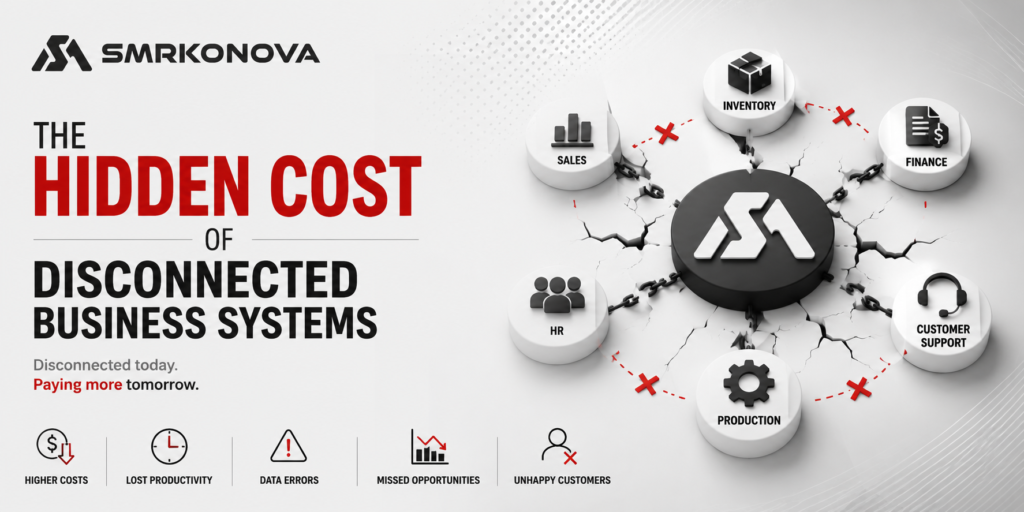
Disconnected business systems are applications, spreadsheets, and processes that operate independently without sharing real-time information. They create duplicate work, inconsistent data, slower decision-making, poor customer experiences, and operational inefficiencies. Connecting these systems through automation, ERP integration, and custom software enables businesses to scale more efficiently while improving visibility and productivity.
What Are Disconnected Business Systems?
Most businesses don’t intentionally create disconnected systems.
They evolve over time.
A CRM is introduced to manage leads.
Finance adopts accounting software.
Operations work from Excel.
Sales communicate through WhatsApp.
Customer support relies on email.
Marketing manages campaigns from another platform.
Individually, every tool works.
Collectively, they don’t.
Instead of information flowing automatically across departments, employees become the bridge between systems—copying data, forwarding emails, updating spreadsheets, and manually syncing records.
This creates delays, duplicate work, and inconsistent information across the organisation.
The issue isn’t the software itself.
It’s that the software was never designed to work together.
Why Disconnected Systems Cost More Than You Think
Many business leaders focus on visible costs such as software subscriptions or employee salaries.
The largest cost is often invisible.
Lost Productivity
Employees spend valuable hours searching for information, updating multiple systems, or correcting manual errors instead of delivering value.
Slower Decision-Making
Without a single source of truth, leadership relies on outdated reports and incomplete information.
Poor Customer Experience
Customers expect fast, consistent responses.
Disconnected systems create delays, duplicate communication, and inconsistent service.
Limited Scalability
Processes that worked with ten employees often become unmanageable with fifty.
Growth amplifies operational friction.
7 Signs Your Business Has a Systems Problem
If your organisation experiences any of the following, it’s likely operating with disconnected business systems:
1. Teams Maintain Multiple Versions of the Same Data
Different departments update different spreadsheets, creating conflicting information.
2. Employees Frequently Re-enter Information
Customer details, invoices, inventory, or project updates are manually copied between systems.
3. Reporting Takes Hours
Instead of accessing live dashboards, employees spend hours preparing reports.
4. Managers Depend on Individuals
If one employee is absent, critical business processes slow down because the knowledge isn’t documented or automated.
5. Customers Repeat Information
Customers shouldn’t have to explain the same issue to multiple departments.
6. Departments Operate Independently
Sales, operations, finance, and marketing rarely share real-time information.
7. Growth Creates More Complexity
Every new employee adds more manual coordination instead of improving efficiency.
Why Buying More Software Isn’t the Solution
One of the biggest misconceptions in digital transformation is believing another platform will solve operational challenges.
It rarely does.
Technology should simplify operations.
Instead, many businesses create technology stacks filled with disconnected applications.
CRM.
ERP.
Accounting.
Project Management.
Inventory.
Marketing Automation.
Customer Support.
Without integration, each becomes another isolated source of information.
Growth doesn’t come from owning more software.
It comes from connecting the software you already have.
The Smrkonova Approach
At Smrkonova, we don’t begin with technology.
We begin by understanding the problems of disconnected business systems.
Before recommending software or automation, we map how information moves across your organisation.
We identify:
- Process bottlenecks
- Disconnected Business Systems
- Communication gaps
- Manual dependencies
- Customer friction
- Data duplication
- Operational inefficiencies
Only then do we engineer a connected digital ecosystem designed specifically around your business.
Our approach combines:
- Business Process Automation
- Custom Software Development
- ERP Integration
- Workflow Optimisation
- Business Intelligence Dashboards
- Premium Website Development
- Digital Customer Experience Engineering
Rather than replacing your existing systems unnecessarily, we help them communicate seamlessly.
The result is a business that works as one connected ecosystem rather than isolated departments.
The Connected Business Framework
Every successful digital transformation follows the same progression.
Business Processes
↓
Connected Systems
↓
Workflow Automation
↓
Business Intelligence
↓
Faster Decisions
↓
Sustainable Growth
This framework ensures technology supports business objectives instead of becoming another operational challenge.
Comparison: Disconnected vs Connected Business Systems
| Disconnected Business Systems | Connected Business Systems |
|---|---|
| Duplicate data entry | Automated data flow |
| Manual reporting | Real-time dashboards |
| Slow approvals | Automated workflows |
| Department silos | Connected collaboration |
| Inconsistent customer experience | Unified customer journey |
| Reactive decisions | Data-driven decision making |
| Limited scalability | Scalable digital infrastructure |
Real-World Business Example
Imagine a manufacturing company receiving an enquiry.
The sales team enters customer details into the CRM.
Operations manually update another spreadsheet.
Finance creates invoices using separate accounting software.
Production tracks progress using Excel.
Customer support communicates through email.
Each department performs the same work independently.
Now imagine the same business with connected systems.
A customer enquiry automatically creates a CRM record.
Production schedules update instantly.
Inventory adjusts automatically.
Finance generates invoices.
Management monitors progress through live dashboards.
Customers receive proactive updates.
The work hasn’t changed.
The system has.
And that’s what transforms productivity.
Business Systems Checklist
Ask yourself these questions:
✔ Does your team update the same information multiple times?
✔ Can management access live operational data?
✔ Are customer interactions tracked in one place?
✔ Do departments share information automatically?
✔ Are repetitive workflows automated?
✔ Can your business scale without increasing administrative work?
If you answered “No” to several of these, your business is likely losing valuable time and resources through disconnected systems.
Why This Matters More in 2026
Artificial Intelligence, predictive analytics, and automation are becoming essential for competitive businesses.
However, these technologies rely on one thing:
Reliable, connected data.
Businesses operating on fragmented systems will struggle to realise the full value of AI because poor inputs produce poor outputs.
The organisations that succeed in the coming years won’t necessarily be those investing in the most technology.
They’ll be the ones investing in the strongest digital foundation.
Frequently Asked Questions
What are disconnected business systems?
Disconnected business systems are software applications and processes that don’t exchange information automatically, resulting in manual work, duplicate data, and operational inefficiencies.
Why are connected business systems important?
Connected systems improve collaboration, reduce manual work, provide real-time visibility, enhance customer experience, and enable businesses to scale efficiently.
Does every business need custom software?
Not always. Many organisations can significantly improve operations by integrating existing platforms. Custom software becomes valuable when business processes require capabilities that standard software cannot provide.
How does business process automation improve efficiency?
Automation eliminates repetitive manual tasks, reduces human error, accelerates approvals, and allows employees to focus on strategic work.
How can Smrkonova help?
Smrkonova helps businesses understand how they operate before designing connected digital ecosystems that combine websites, automation, ERP integration, business intelligence, and custom software into one seamless growth platform.
Conclusion
Technology alone doesn’t create competitive advantage.
Connected systems do.
As businesses grow, operational complexity increases.
Without integrated workflows, reliable data, and intelligent automation, growth eventually slows under the weight of manual processes and disconnected information.
The most successful businesses of the next decade won’t be those using the most software.
They’ll be the ones whose technology works together seamlessly.
That’s exactly what we build at Smrkonova—connected digital ecosystems that help businesses operate smarter, respond faster, and scale sustainably.
Call to Action
Is your business running on disconnected systems?
Let’s uncover the hidden costs together.
Whether you’re looking to streamline operations, integrate ERP systems, automate workflows, or build custom software tailored to your business, Smrkonova can help you engineer a connected foundation for long-term growth.
Book your free business systems consultation today.
Pingback: The Biggest Marketing Myth in 2026: Why More Marketing Won't Fix a Broken Business